
I will start this article with a confession.
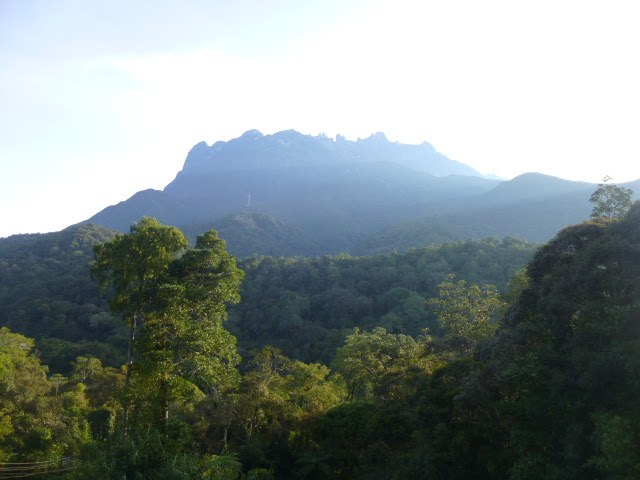
When my father and I hiked Mount Kinabalu in Malaysia in 2015, we had absolutely no idea that we were climbing the highest mountain in Malaysia and the highest mountain in Southeast Asia.
None.
Zero.
For us, the decision-making process was basically:
— The weather looks good.
— The mountain looks interesting.
— Should we go up?
— Yep.
That was the whole strategy.
These days, when I prepare for a hike, I compare boots, analyze pack weight, assess objective hazards, check the weather, and think about hydration, nutrition, and recovery.
Back then, our risk management system looked more like an old Windows XP machine running on faith and optimism.
The setup
I would love to tell you we were equipped like professionals.
Unfortunately for the credibility of this article:
Foldable Dollarama backpack.
Worn-out running shoes.
One litre of water.
A few snacks.
Completely unjustified confidence.
That was it.
I know.
I can already see you opening a new tab to check whether I am still suffering consequences from that decision.
Surprisingly, no.
Why we did it in one day
At the time, most people climbed to the mountain hut, slept there, then continued to the summit for sunrise.
Except we had already seen a spectacular sunrise a few days earlier from the top of Mount Batur in Indonesia.
So we were not especially motivated to pay for another night on a mountain.
The truth is much less impressive.
We did not decide to climb Kinabalu in one day because we had developed a particularly sophisticated alpine strategy.
We mostly wanted to avoid the cost of the hut and we had absolutely no idea how high the mountain actually was.
For us, at the time, Kinabalu was basically:
“A mountain that looks interesting.”
The Malaysian version of Mont Saint-Hilaire.
The conversation with the ranger
We asked whether we could simply go up and come back down in the same day.
The ranger looked at us.
We probably looked far too confident. Or far too ignorant. Possibly both.
After a few exchanges, he asked us to sign a waiver.
Which probably should have made us think a little harder.
Instead, we interpreted it as:
“Excellent. We now have official permission.”
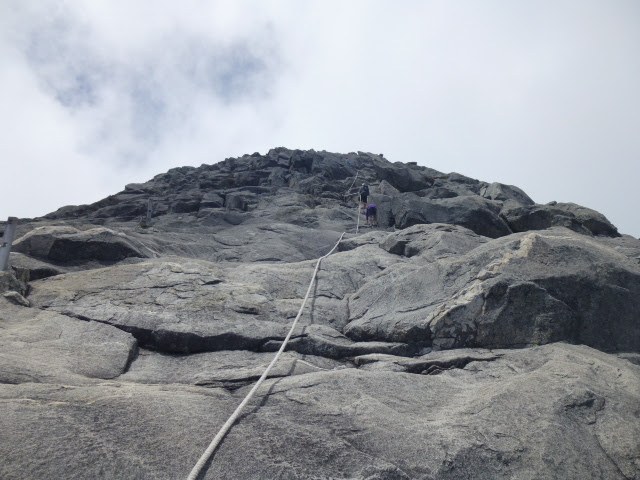
Satan’s stairs
There is another detail the tourist brochures mention surprisingly little.
The stairs.
To be clear: not wooden stairs.
Rocks.
High rocks.
Semi-natural, knee-height rock steps that only technically qualify as stairs because humans kept walking up them.
More rocks.
Always rocks pretending to be stairs.
Some of them seemed positioned specifically to test the structural integrity of human quadriceps.
Several times, I wondered whether the mountain had ever consulted an average human leg.
I suspect not.
The trail seemed to operate on one core design principle:
“What if every step came up exactly to knee height?”
And everyone decided knees could adapt.
The summit view
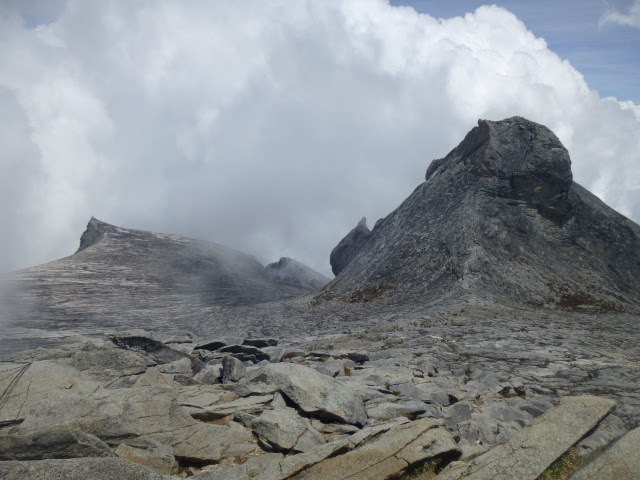
When we finally reached the summit, we were above the clouds.
Which is very impressive meteorologically.
Visually, the situation was slightly less dramatic.
The view consisted mainly of:
Clouds.
Grey.
Everywhere.
Technically, it was beautiful.
Objectively, I was happy to be there.
But if you are looking for a postcard photo showing all of Borneo stretching to the horizon, you may be disappointed.
Personally, that never really bothered me.
I have always been much more interested in the experience than the view.
The view is a bonus.
The consequences
To be perfectly honest, I have never been that sore in my entire life.
Not before.
Not after.
Not after the army.
Not after multi-day hikes.
Not after anything else.
The day after Kinabalu, my quadriceps had officially stopped cooperating with normal human activity.
Walking down stairs the conventional way was no longer an option.
I went down sideways.
Like a confused crab.
At one point, I seriously considered the possibility of simply sitting somewhere and staying there until the end of the day.
The scientific data remains incomplete.
But I have a few hypotheses.
Then the mountain reminded us of something
One week after our climb, a major earthquake hit the Kinabalu region.
Rockfall occurred.
People died.
That part of the story is less funny.
But it matters.
Because it illustrates something I learned much later in the mountains.
We spend a lot of time worrying about the risks we can see.
The boots.
The pack.
The food.
The water.
The clothing.
But some of the most important risks are invisible, unpredictable, and outside our control.
Objective hazard exists even when we do not see it.
Ten years later
A decade later, I randomly came across a piece of information about Mount Kinabalu.
The highest mountain in Southeast Asia.
“Excuse me?”
“The what?”
I sat in front of my screen for a few seconds trying to reconcile two realities:
A mountain of continental significance.
The very precise memory of my foldable Dollarama backpack.
It was not an exceptional achievement.
Thousands of people climb Kinabalu every year.
What made me laugh was mostly the contrast between the importance of the mountain and the level of research we had done before setting foot on it.
What I would do differently now
More water.
Much more water.
More snacks.
A better understanding of the route.
A better understanding of the mountain.
Probably better shoes too.
Although, honestly, the foldable Dollarama backpack remains hard to beat on a performance-to-price ratio.
The real lesson
Back then, we succeeded despite some bad decisions.
Today, I prefer succeeding because of good decisions.
The lesson is not that everyone should climb Kinabalu with minimalist gear.
The lesson is that gear should always fit the context.
That is much less exciting.
But it is also much more repeatable.
And usually better for the knees.
Especially once they have already survived a few adventures.